
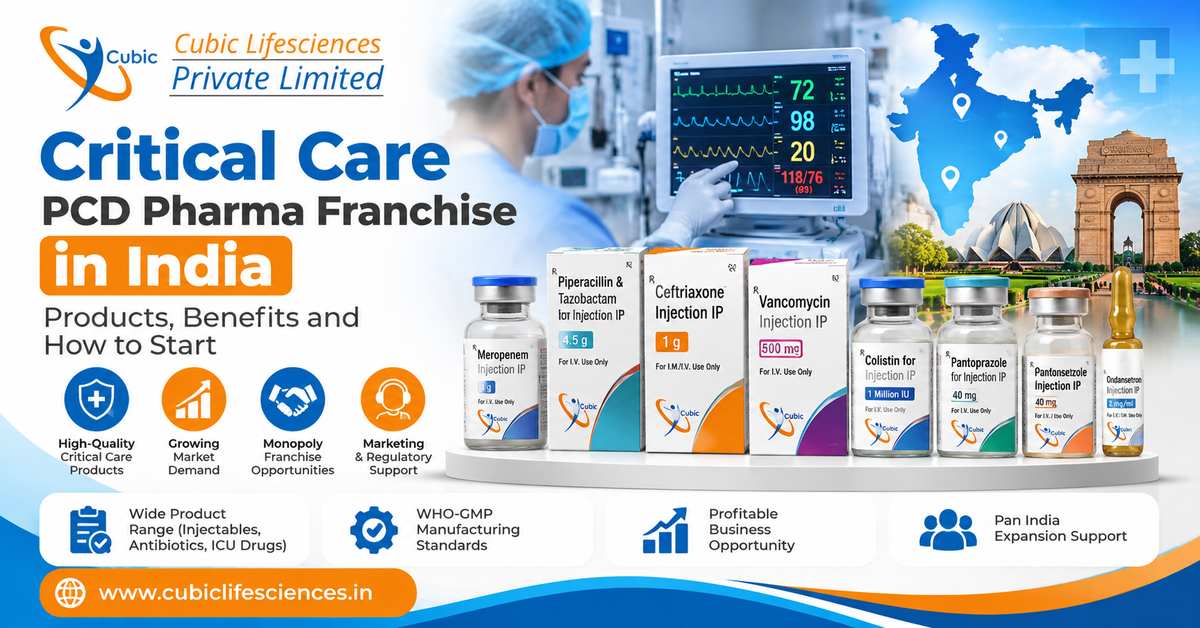
Critical care medicines are the injections hospitals use in ICUs, casualty wards and operation theatres, such as strong antibiotics, stomach-protection injections and anti-vomiting injections. They are rarely sold over a chemist’s counter, yet every hospital needs them daily and uses them up quickly. For pharma distributors and medical representatives who want to work with hospitals, critical care is one of the most stable areas of the PCD business.
A Critical Care PCD Pharma A franchise in India gives a distributor the right to sell a company’s critical care range under its brand in a fixed area, without owning a factory. In this blog we cover what the franchise is, why demand keeps growing, which products sell, the licence needed, the money involved and how to pick a good company. The critical care injections made by Cubic Lifesciences are listed near the end.
What Is a Critical Care PCD Pharma Franchise?
PCD stands for Propaganda Cum Distribution. A pharma company manufactures and packs the products under its own brand, and you get the right to promote and sell them in an agreed area. You don’t need a factory or your own product approvals. Your job is the market.
For a critical care partner, that market means hospitals more than anything. ICU wards, casualty, the operation theatre, surgical floors, nursing homes, the big multi-specialty places on the highway. You’ll spend less time with corner chemists and more with the person running the hospital pharmacy, the purchase manager, and the doctors who decide what goes into a drip, like the intensivist, the surgeon and the anaesthetist. Nearly everything you sell is an injection, because a patient who’s that unwell often can’t swallow a tablet.
Why Critical Care Products Are in Demand in India
Hospitals have been growing fast across the country. Drive through almost any mid-sized city, and you’ll spot a new multi-speciality hospital going up, while the older nursing homes are knocking down walls to squeeze in a few ICU beds. Every one of those beds needs injections every day.
Patient numbers are rising alongside. Serious infections, road accidents, surgeries, dengue and malaria in the monsoon, and kidney and diabetes problems all bring people into hospital. Once admitted, most patients are started on injections, because they work faster and don’t need the patient to swallow anything.
And unlike many products, critical care medicines aren’t optional. A hospital can delay buying furniture. But no hospital can put off buying antibiotics for a patient in the ICU. Demand like that keeps coming back, month after month, and the weather has very little to do with it.
Common Critical Care Products and Their Uses
Here’s a quick look at the main groups of critical care products and where hospitals use them.
| Product Group | Common Examples | Where It’s Used |
| Strong antibiotic injections | Ceftriaxone (with sulbactam or tazobactam), cefoperazone with sulbactam, piperacillin with tazobactam, meropenem, and amikacin | Serious infections in wards and ICUs |
| Stomach-protection injections | Pantoprazole, rabeprazole | Admitted patients who can’t take tablets, before and after surgery |
| Anti-vomiting injections | Ondansetron | After surgery, during chemotherapy, severe vomiting |
| Painkiller injections | Diclofenac | Strong pain after injuries and operations |
| Iron injections | Iron sucrose | Iron deficiency anaemia, especially in pregnancy and kidney disease |
| Vitamin injections | Methylcobalamin | Nerve support and recovery |
| Antimalarial injections | Arteether | Malaria, mostly in the monsoon months |
All of these are prescription medicines, given under a doctor’s supervision, mostly in hospitals. The strongest antibiotics, meropenem in particular, are kept for serious or resistant infections, and good doctors use them sparingly.
Benefits of a Critical Care PCD Franchise
Steady Hospital Demand:
A busy hospital uses injections every hour of every day. Once your products are on its approved list, orders come in regularly, without the ups and downs of seasonal products.
Larger Order Sizes:
Put a hospital pharmacy’s monthly order next to a chemist shop’s, and the difference is obvious. One busy hospital can buy more than several chemists put together, so you don’t need a long list of customers to make the numbers work.
Good Value Per Product:
A vial of a strong antibiotic is worth a good deal more than a strip of everyday tablets. Same visit, same effort, bigger bill.
Fewer, Stronger Relationships:
The circle is small, with a handful of hospitals and the doctors inside them. Once they trust your quality and your delivery, they tend to stay because no doctor likes changing what goes into an ICU patient without a very good reason.
How to Start a Critical Care PCD Pharma Franchise in India
Begin with a map, even a rough one in a notebook. Note down every multi-speciality hospital, nursing home with ICU beds, surgical centre and casualty unit in your area. Then go and see the people who run their pharmacies. Ask what they go through fastest, whose brands are on the shelf now, and where a supplier has let them down.
The licence side is the same as any wholesale business: a drug licence on Forms 20B and 21B from your state’s licensing office plus GST registration. Injections are fussier about storage, though, so your room needs to be clean, dry and out of the sun and heat. A registered pharmacist, or someone with the right experience, has to be named on the licence.
Then compare two or three companies with a good injectable range. Get their product lists and certificates, ask for a few sample vials and the rate sheet, and find out how many days dispatch really takes. Once you’ve decided, the products, your area, any target and how long the deal runs all go into a written agreement.
Don’t start with everything. Begin with what local hospitals already use every day, which is usually a couple of ceftriaxone combinations, a pantoprazole injection and ondansetron. Meropenem and piperacillin with tazobactam can follow once the ICU and surgical teams know you and trust your stock.
How to Choose a Critical Care PCD Company
Quality comes before everything else here. The patients getting these injections are already in a bad way, and a poorly made vial can make things worse. Ask where the plant is, read the WHO-GMP certificate yourself, including its date, and ask whether antibiotics like ceftriaxone and piperacillin are made in their own separate block, which beta-lactam antibiotics need.
Pick up a vial and look at it. The powder inside should be dry and even, the rubber stopper and seal untouched, and you should be able to read the strength, batch number and expiry without squinting. Vials packed with their own sterile water save the nurses a step on a busy shift.
Check supply carefully. Hospitals can’t wait for stock. If a supplier runs out of an antibiotic, the pharmacy simply buys another brand, and that brand may stay on the shelf for good. Ask the company plainly how fast orders are dispatched and how it handles urgent needs.
Look at the range. A company that covers antibiotics, stomach-protection injections, anti-vomiting, pain, iron and vitamin injections lets you serve an entire hospital from one supplier.
Monopoly in Critical Care PCD Franchise
Some companies offer monopoly rights, which means no other partner of the same company can sell the same products in your area. Getting your injection onto a hospital’s list takes months of visits, so it’s worth protecting. If you’re offered a Monopoly Critical Care PCD Franchise, have the area, the products, the time period and any monthly target put in writing.
Investment and Payments:
There’s no fixed figure. It comes down to how many products you pick, how much of each, the company’s minimum order, freight and what you spend setting up storage. Vials cost more than tablet strips, so even a modest first order can look bigger on paper.
Plan for credit. Hospitals and nursing homes often pay after 30 to 60 days or more, while the company wants payment for your next order. Keep enough working money aside so a slow-paying hospital doesn’t stop you from restocking another one.
Why Choose Cubic Lifesciences for Critical Care?
Cubic Lifesciences is a WHO-GMP- and ISO-certified pharma company that works with more than 2,000 customers across India. We offer marketing materials, samples, visual aids and training for our franchise partners, along with competitive pricing. Our wider range also covers tablets and capsules, syrups, cardiac and diabetic products, drops, ointments and more, so a critical care partner can grow into other segments with us.
Our injectable range has 27 products. These are the critical care injections most partners start with:
| Product | Composition | Used For |
| Meropenem Injection | Meropenem 1000 mg | Serious and hospital infections |
| Piperacillin and Tazobactam Injection | Piperacillin 4 g + Tazobactam 0.5 g | Serious infections in ICU and wards |
| PIPMAP-2.25 | Piperacillin 2 g + Tazobactam 0.25 g | Serious infections |
| BICZONE-S 1500 | Cefoperazone 1000 mg + Sulbactam 500 mg | Serious infections |
| Ceftriaxone 1000 mg and Sulbactam 500 mg Injection | Ceftriaxone 1000 mg + Sulbactam 500 mg | Hospital infections |
| Ceftriaxone 1000 mg and Tazobactam 125 mg Injection | Ceftriaxone 1000 mg + Tazobactam 125 mg | Hospital infections |
| CEFTOQUB S-750 | Ceftriaxone 500 mg + Sulbactam 250 mg | Infections |
| Ceftriaxone 1000 mg Injection | Ceftriaxone 1000 mg | Infections |
| Amikacin Sulphate Injection | Amikacin 500 mg | Hospital infections |
| Amoxycillin and Potassium Clavulanate Injection | Amoxycillin 1000 mg + Clavulanate 200 mg | Infections |
| Pantoprazole Injection | Pantoprazole 40 mg | Acidity and ulcer prevention in admitted patients |
| Rabeprazole Injection | Rabeprazole 20 mg | Acidity and ulcer prevention |
| Ondansetron Injection | Ondansetron 2 mg | Vomiting after surgery or chemotherapy |
| Diclofenac Sodium Injection | Diclofenac 75 mg | Strong pain |
| Iron Sucrose Injection | Iron Sucrose 100 mg | Iron deficiency anaemia |
| A-B Arteether Injection | Alpha-Beta Arteether | Malaria |
If you’re looking for a Critical Care PCD Company in India with a ready injectable range, call or message our team for the full product list and rates, and to check whether your area is available.
Conclusion:
Critical care is one of the steadier parts of the pharma business. Hospitals keep opening, ICU beds keep filling, and the injections they run on are needed every single day, whatever the season. For a franchise partner who supplies on time, that turns into regular, repeat orders from a small group of loyal buyers.
It asks more of you than a general range, no doubt. The quality has to be beyond question, deliveries have to be quick, and you’ll need patience with hospital payments. Start with what local hospitals already use, earn the trust of the pharmacy and ICU staff, and bring in the stronger antibiotics as that trust grows.
If you’re ready to start a Critical Care PCD Pharma Franchise in India, Cubic Lifesciences would be glad to work with you. With a WHO-GMP certified injectable range, marketing support and competitive pricing, we can help you build a steady hospital business. Reach out to our team for the product list and rates.
Frequently Asked Questions:
Q.1 What is a critical care PCD pharma franchise?
Ans. Put simply, a pharma company lets you sell its critical care products, which are mostly injections, under its brand in a set area. You keep hospitals, nursing homes and ICUs supplied.
Q.2 Who buys critical care products?
Ans. Hospitals, nursing homes, ICUs, casualty departments and surgical centres, through their pharmacies, along with the intensivists, surgeons, anaesthetists and physicians who write the orders.
Q.3 Which critical care injections sell the most?
Ans. In most hospitals, ceftriaxone and its combinations, pantoprazole and ondansetron move fastest, with piperacillin-tazobactam and meropenem close behind in the ICU.
Q.4 Which licence is needed?
Ans. A wholesale drug licence on Forms 20B and 21B from your state’s drug licensing authority, along with GST registration and proper storage for injections.
Q.5 Is a critical care franchise more expensive to start?
Ans. Usually, yes. Injections cost more per unit, so the first order is bigger in value, and hospitals often pay after 30 to 60 days, so you’ll need some money in reserve.
Q.6 How should critical care injections be stored?
Ans. Somewhere clean and dry, below the temperature printed on the label, and away from heat and sunlight. Check each product’s storage line, as they differ.
Q.7 Does Cubic Lifesciences have a critical care range?
Ans. Yes. Our injectable range has 27 products, including meropenem, piperacillin with tazobactam, ceftriaxone combinations, pantoprazole, ondansetron and iron sucrose.