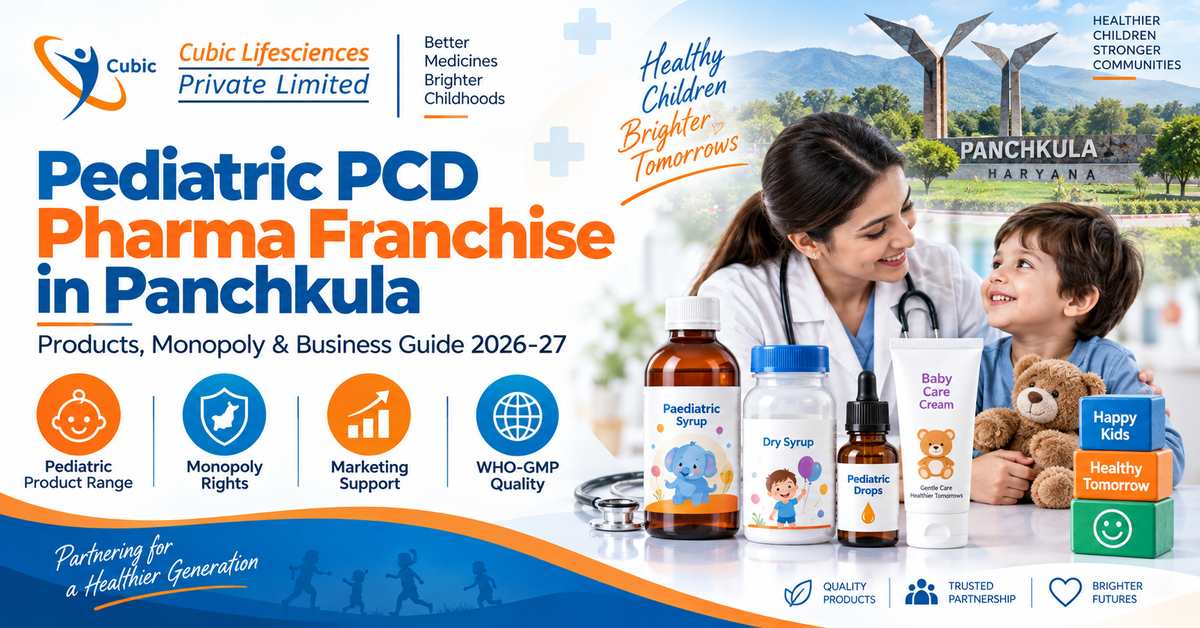
Panchkula has grown into one of the more active pharma hubs in North India, and pediatric care makes up a decent chunk of that activity. Parents take their kids to the pediatrician more readily than they used to, and that alone has pushed real demand for dedicated pediatric formulations — drops, dry syrups, suspensions, the works. For pharma professionals and entrepreneurs eyeing this segment, a Pediatric PCD pharma franchise in Panchkula is worth serious consideration.
Cubic Lifesciences operates out of Panchkula and offers PCD Pharma Franchise opportunities with a dedicated pediatric range alongside its broader pharmaceutical portfolio. Before signing up with any company, though, it helps to actually understand how the model works, what products make sense, how monopoly rights function, and what to verify before committing.
Why Panchkula Works for a Pediatric PCD Pharma Franchise
Panchkula sits right next to Chandigarh and Mohali, which means a franchise partner here isn’t just working one city — the whole Tricity region and its surrounding markets come into play. That’s a meaningful advantage for anyone trying to build volume in pediatric products specifically, since demand tends to be steadier here than in smaller, single-city territories.
The region also has a fair number of manufacturing units and pharma companies already based locally, Cubic Lifesciences among them. That proximity can simplify supply and communication in ways a partner working with a distant company just doesn’t get.
None of that replaces real homework, though. Local competition, existing pediatrician and pharmacy networks, and actual product demand still need to be checked before anyone commits capital.
What Is a Pediatric PCD Pharma Franchise?
A Pediatric PCD pharma franchise is a franchise arrangement where a pharmaceutical company hands over its paediatric-focused products — drops, syrups, suspensions, tablets built for children — to a franchise partner who then markets and distributes them within an agreed territory.
The company generally handles manufacturing, packaging, and supply. The partner’s job is building the market — getting products in front of paediatricians, chemists, and clinics, and keeping that relationship going.
It’s a narrower slice of the general PCD model, and that narrowness is actually the point. A partner focused specifically on pediatric formulations can build deeper relationships with paediatricians instead of trying to be everything to everyone.
Why Consider Cubic Lifesciences for Pediatric PCD Pharma Franchise in Panchkula?
Cubic Lifesciences is a Panchkula-based pharmaceutical company that’s built out a fairly wide portfolio over the years — tablets, capsules, syrups, suspensions, injectables, ointments, and a dedicated pediatric range sitting alongside all of it.
Dedicated Pediatric Product Range:
The pediatric line covers drops, dry syrups, and suspensions across several categories — antibiotics, cough and cold, steroid-based suspensions, multivitamin drops, and more. Products like Podmap dry syrup (a cefpodoxime-based antibiotic) and Qubcort oral suspension are part of this range, formulated specifically for children rather than adapted from adult dosing.
A dedicated line like this matters because paediatric formulations genuinely differ from general medicine — flavor, dosing precision, and packaging all need to work for a child patient and a worried parent at the same time.
Manufacturing & Quality Standards:
Cubic Lifesciences positions its manufacturing around WHO-GMP and ISO 9001:2015 standards. As with any company making that claim, ask for the current certificates and confirm exactly which facility they apply to before you order — a certificate that isn’t tied to the actual manufacturing unit for your products doesn’t tell you much.
Monopoly-Based Franchise Opportunities:
The company offers monopoly-based franchise opportunities, meaning a partner can get exclusive distribution rights for specific products within an agreed territory. As always, get the exact boundary, the products covered, and the duration written into the agreement rather than assumed from a conversation.
Promotional & Marketing Support:
Franchise partners can typically expect visual aids, product cards, and technical literature as part of the marketing toolkit — though what’s actually included should be confirmed against your specific agreement rather than general marketing claims.
Franchise Assistance:
Ongoing support around product availability, orders, and territory questions matters more in the paediatric segment than people expect, mainly because stock delays hit differently when a worried parent is standing at a pharmacy counter.
Pediatric Product Categories to Consider
Pediatric Drops:
Multivitamin drops, antibiotic drops, and other concentrated formulations are meant for infants and very young children, where dosing needs to be precise and small.
Dry Syrups:
Dry syrup powders — reconstituted with sterile water just before use — are common in pediatric antibiotics because they hold potency better than a pre-mixed liquid sitting on a shelf.
Oral Suspensions:
Suspensions cover a wider range of pediatric needs — anti-inflammatory, steroid-based, and general formulations that get administered by the spoonful or dropper.
Paediatric Tablets:
Chewable or easily dispersible tablets round out a pediatric portfolio for slightly older children who can manage a tablet form.
How Do Monopoly Rights Work in a Pediatric PCD Franchise?
Monopoly rights in this context mean the company agrees not to appoint another franchise partner for the same pediatric products within your defined territory. It’s not a blanket guarantee against all competition — other companies’ pediatric brands can still operate in the same area.
Before accepting monopoly terms, confirm the exact geographical boundary, which products the exclusivity actually covers, how long the agreement runs, and what conditions might affect renewal. Written terms protect you far better than a verbal assurance ever will.
How to Choose a Pediatric PCD Pharma Company in Panchkula?
Start with the product range itself — does it actually cover what paediatricians in your target area are prescribing, or does it just look broad on paper?
Check manufacturing information and ask for current quality documentation rather than taking certification claims at face value.
Compare pricing, minimum order requirements, payment terms, and stock availability. Pediatric products especially need reliable supply — a stock-out here costs you credibility with pediatricians fast.
Understand what promotional support is genuinely included, and get the monopoly terms and territory boundaries documented in writing before you place your first order.
How Much Investment Is Required for a Pediatric PCD Franchise in Panchkula?
There’s no single fixed figure that applies across the board. Investment depends on the number of products selected, opening stock quantities, pricing, minimum order conditions, marketing expenses, and working capital set aside for repeat orders.
Rather than working off a generic number, get a product-wise quotation from the company and build your budget around your actual selected portfolio.
How to Start a Pediatric PCD Pharma Franchise in Panchkula?
Begin by researching the local pediatric market — which paediatricians, clinics, and pharmacies are active, and what they’re already prescribing.
Decide on a territory you can realistically service and confirm its availability with the company.
Compare companies on product range, manufacturing standards, documentation, monopoly terms, and support — not just price.
Once you’ve shortlisted a company, select a focused opening portfolio rather than the entire catalogue, finalise the commercial terms, and get the agreement documented properly before placing your order.
Who Can Start a Pediatric PCD Pharma Franchise?
Pharma distributors, wholesalers, medical representatives, and entrepreneurs with relevant market knowledge can all explore this business. Anyone already connected with pediatricians or paediatric-focused pharmacies has a genuine head start here.
New entrants can enter too, but should first understand licensing requirements, inventory handling, and what pediatric-specific compliance actually looks like before investing.
Is a Pediatric PCD Pharma Franchise Profitable?
There’s real commercial potential in this segment, but no franchise model guarantees profit. Actual results depend on product demand, pricing, sales volume, competition, credit management, stock movement, and how well the territory gets developed.
Keep gross margin and net profit separate in your planning — transport, promotional costs, and unsold stock all eat into the final number.
Future Scope of Pediatric PCD Pharma Franchise in Panchkula
Pediatric healthcare demand isn’t slowing down, and that steady baseline makes this one of the more resilient segments within PCD pharma. Growth going forward will likely depend on product relevance, consistent supply, and how well a partner builds relationships with the local pediatric community — not just on adding more SKUs to the catalogue.
Final Checklist Before Choosing a Pediatric PCD Company in Panchkula
Before finalising a company, verify the pediatric product portfolio, manufacturing information, applicable quality certifications, pricing, monopoly conditions, territory availability, minimum order requirements, stock availability, promotional support, and written franchise agreement.
Conclusion
Starting a Pediatric PCD pharma franchise in Panchkula gives entrepreneurs a way to build a focused pharmaceutical business around a genuinely stable, always-in-demand segment.
Cubic Lifesciences is worth considering given its Panchkula base, dedicated pediatric product range, and monopoly-based franchise model. As with any company, confirm the latest product catalogue, current territory availability, and commercial terms directly before entering into an agreement.
A focused product selection, proper documentation, and realistic working-capital planning give a much stronger foundation than chasing the biggest catalogue available.
Frequently Asked Questions:
Q.1 What is a Pediatric PCD pharma franchise?
Ans. It’s a franchise arrangement where a pharmaceutical company provides paediatric-focused products — drops, dry syrups, suspensions, and tablets for children — to a partner who markets and distributes them within an agreed territory.
Q.2 Does Cubic Lifesciences offer monopoly franchise opportunities?
Ans. Yes, subject to territory availability and current company terms. Confirm the exact boundary and conditions before entering an agreement.
Q.3 What pediatric products does Cubic Lifesciences offer?
Ans. Its paediatric range includes drops, dry syrups, and oral suspensions covering antibiotics, cough and cold formulations, steroid-based suspensions, and multivitamin drops, among others.
Q.4 How much investment is required for a Pediatric PCD franchise in Panchkula?
Ans. There’s no fixed amount — it depends on product selection, opening stock, pricing, minimum order requirements, and working capital. Request a product-wise quotation to plan accurately.
Q.5 Is a Pediatric PCD pharma franchise profitable?
Ans. It can have real commercial potential, but profitability isn’t guaranteed. Results depend on demand, pricing, competition, and how well the business is actually run.